
What Are the Weather Resistance Testing Standards for PVC Foam Boards?
PVC foam boards, known for their lightweight, waterproof, and thermal insulation properties, have become a popular material 3mm white pvc sheet in various fields such as construction, advertising, and agriculture. To ensure their long-term performance in outdoor environments, weather resistance testing is crucial. This article explores the key weather resistance testing standards for PVC foam boards, covering aspects such as UV resistance, thermal stability, and moisture resistance 3mm white pvc sheet.
1. UV Resistance Testing
Testing Principle
UV resistance testing evaluates how well PVC foam boards withstand prolonged exposure to ultraviolet (UV) radiation, which can cause material degradation, color fading, and surface cracking.
Testing Standards
ISO 4892-3: This standard specifies methods for exposing plastics to UV radiation in a controlled environment, simulating natural sunlight. It involves using a xenon arc lamp or fluorescent UV lamp to irradiate the sample for a specified period, typically ranging from hundreds to thousands of hours 3mm white pvc sheet.
ASTM G154: Similar to ISO 4892-3, this standard outlines procedures for fluorescent UV exposure of nonmetallic materials. It is widely used in the United States and provides detailed guidelines for cycle conditions, such as UV exposure time, condensation cycles, and temperature control 3mm white pvc sheet.
Testing Procedure
Sample Preparation: Cut PVC foam board samples into standard sizes (e.g., 150mm × 75mm).
Exposure: Place samples in a UV weathering tester, setting the appropriate UV intensity, temperature, and humidity conditions 3mm white pvc sheet.
Evaluation: After exposure, assess the samples for color change, surface cracking, and other signs of degradation using instruments like a colorimeter or a microscope.
2. Thermal Stability Testing
Testing Principle
Thermal stability testing evaluates how PVC foam boards perform under extreme temperature conditions, including high-temperature exposure and thermal cycling 3mm white pvc sheet.
Testing Standards
ISO 75: This standard measures the heat deflection temperature (HDT) of plastics, indicating the temperature at which a material deforms under a specified load.
ASTM D648: Similar to ISO 75, this standard provides a method for determining the HDT of plastics using a three-point bending test.
Thermal Cycling Test: While not covered by a single international standard, thermal cycling involves subjecting samples to alternating high and low temperatures to simulate seasonal changes. Common cycles include -40°C to +80°C or -20°C to +60°C, with each cycle lasting several hours 3mm white pvc sheet.
Testing Procedure
Sample Preparation: Prepare PVC foam board samples according to the standard dimensions required for the test.
High-Temperature Exposure: Place samples in an oven at a specified temperature (e.g., 80°C) for a set period (e.g., 24 hours) 3mm white pvc sheet.
Thermal Cycling: For thermal cycling tests, transfer samples between high-temperature and low-temperature chambers according to the predefined cycle 3mm white pvc sheet.
Evaluation: After testing, inspect samples for warping, cracking, or other forms of deformation. Measure dimensional changes using calipers or a coordinate measuring machine (CMM).
3. Moisture Resistance Testing
Testing Principle
Moisture resistance testing assesses how PVC foam boards absorb and resist water, which can affect their dimensional stability, mechanical properties, and durability 3mm white pvc sheet.
Testing Standards
ISO 62: This standard specifies methods for determining the water absorption of plastics by immersion in water.
ASTM D570: Similar to ISO 62, this standard provides a procedure for measuring the water absorption of plastics over a specified period.
Humidity Aging Test: This test involves exposing samples to high humidity conditions (e.g., 85% RH at 50°C) for an extended period to evaluate their resistance to moisture-induced degradation.
Testing Procedure
Sample Preparation: Cut PVC foam board samples into standard sizes and weigh them using a precision balance.
Immersion Test: Immerse samples in distilled water at a specified temperature (e.g., 23°C) for a set period (e.g., 24 hours or 7 days).
Humidity Aging Test: Place samples in a humidity chamber set to the desired temperature and humidity conditions for the required duration.
Evaluation: After testing, remove samples, wipe off surface moisture, and reweigh them to calculate water absorption. Inspect samples for swelling, delamination, or other signs of moisture damage.
4. Additional Considerations
Combined Weathering Tests
In practice, PVC foam boards are often subjected to combined weathering tests that simulate multiple environmental factors simultaneously. For example, a xenon arc weathering tester can combine UV radiation, moisture, and temperature cycling to provide a more realistic assessment of long-term performance.
Material Variations
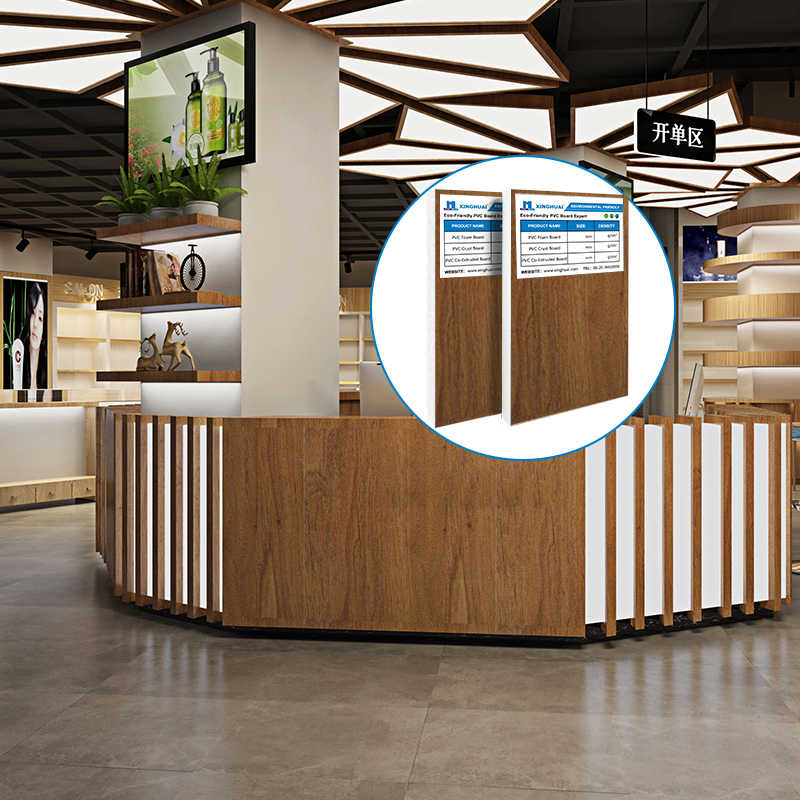
The weather resistance of PVC foam boards can vary depending on their formulation, density, and surface treatment. For instance, 3mm white PVC sheet may exhibit different UV resistance compared to PVC sheet wooden colour due to variations in pigment types and concentrations. Similarly, 7ft foam board (a larger-sized board) may require additional testing to ensure uniform performance across its entire surface.
Application-Specific Testing
For specific applications, such as PVC foam wall panels used in exterior cladding, additional tests may be required to evaluate fire resistance, impact resistance, and wind load capacity. These tests ensure that the material meets the relevant building codes and safety standards.
Conclusion
I test di resistenza agli agenti atmosferici sono essenziali per garantire le prestazioni e la durata a lungo termine dei pannelli in schiuma di PVC nelle applicazioni esterne. Aderendo a standard internazionali come ISO 4892-3, ISO 75 e ISO 62, produttori e utilizzatori possono valutare la resistenza del materiale ai raggi UV, allo stress termico e all'umidità, selezionando così il prodotto più adatto alle proprie esigenze. Che si tratti di foglio di PVC bianco da 3 mm per la pubblicità o Pannelli murali in schiuma di PVC per la costruzione, la comprensione e l'implementazione di questi standard di prova sono fondamentali per ottenere soluzioni affidabili e convenienti.
